
Free Air Delivery, FAD, is one of the most mysterious units in compressed air land. Surrounded by many different definitions and shrouded in mystery. So let's clear it up.
FAD is the unit we use when talking about the capacity of an air compressor. It lets us compare apples to apples. The best definition I can give you is:
FAD = the flow at the compressor outlet, calculated back to inlet conditions.
But that doesn't really explain anything, does it?
To understand this, just think of a compressor that compresses air at a certain rate. We let the compressed air blow free, so it expands back to ambient conditions. And that is what we 'measure' when we talk about FAD.
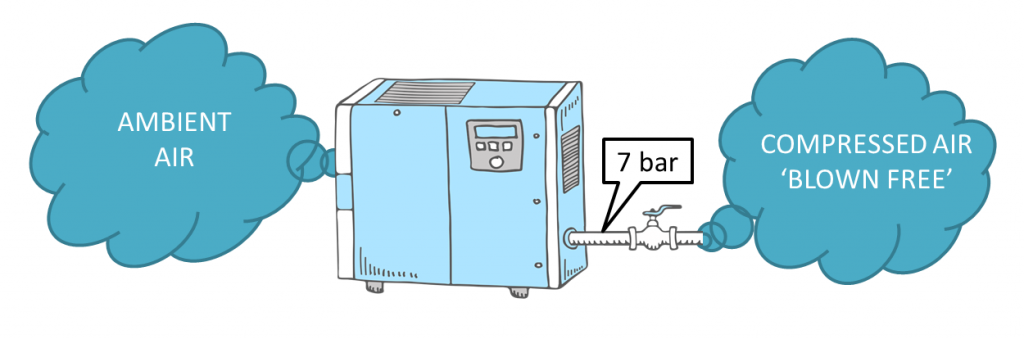
FAD vs the actual air flow in the pipe
Always remember: when we are talking about compressor capacity, we are talking about FAD, or at least 'normalized' airflow. The actual air flow in the pipe is much smaller.
Roughly speaking, at 7 bar (gauge pressure), the air is 8 times compressed. So 8 cubic meters of input air flows through the compressed air piping as 1 cubic meter of compressed air. If the compressor takes in 8 cubic meters per minute of actual ambient air, that results in an air flow of 1 cubic meter per minute of compressed air.
But we are NOT talking about this air flow when talking about compressor capacity. Why? First, because ambient inlet conditions are different. Second, if we compress the air more (increase pressure), the volume becomes smaller and the air flow would become smaller too. The actual air flow in the pipe changes, but the FAD stays the same.
Take a simple piston compressor that makes 1 stroke per second. Every stroke pumps in 1 liter of ambient air. No losses, to keep things simple. If we pump air with this compressor into an empty air receiver (0 bar gauge, 1 bar absolute), the flow at the inlet and the outlet of the compressor is the same. If we pump air at 10 bar absolute pressure, the air is compressed 10 times. The actual air flow in the pipe is now only 0.1 l/s of compressed air.
As we go up in pressure, the flow of air in the pipe becomes slower. But the amount of air taken in (the FAD) stays the same. In reality, the FAD of a compressor will go down a little with higher pressure, because of losses inside the compressor itself.
Air mass flow
We use 'normal' or 'standard' conditions to compare compressor outputs objectively. What we are actually doing here is talking about the mass-flow of air. A certain volume of air (a cubic meter, a cubic foot) at a standardized temperature and pressure has a fixed mass: the weight of the air.
So by using normal liters per minute or standard cubic feet per minute, we are actually describing a fixed mass flow per minute. In the example above (the small piston compressor), the mass flow of air at the inlet of the compressor is the same as at the outlet, whether the air is under pressure or 'blown free' afterwards. No matter the pressure. We are moving a fixed mass of air, but the actual volume of that air is different with temperature and pressure.
It would be weird to talk about an air compressor with a capacity of kilograms per minute though, right? For example: a cubic meter of air weighs 1.20 kg at 20 °C and 1.013 bar (absolute). So a compressor with a capacity of 7 m³/min FAD has a capacity of about 8.4 kg/min.
Reference conditions and datasheets
To make a fair comparison, we use standardized inlet conditions and a standardized measurement method, as described in ISO 1217. Another way of expressing the same idea is nl/s (normal liters per second) or SCFM (standard cubic feet per minute). The only difference is the reference conditions:
| Rating | Temperature | Pressure (absolute) |
|---|---|---|
| FAD (ISO 1217) | 20 °C | 1.013 bar |
| nl/s ('normal') | 0 °C | 1.013 bar |
| SCFM ('standard') | 60 °F / 15.6 °C | 14.696 psi / 1.013 bar |
Of course, real inlet conditions are different depending on the location. So when only "FAD" is mentioned on a datasheet, it should also say what reference conditions were used. When you compare two compressors by FAD, check that they are both rated against the same reference conditions. Otherwise you are comparing apples to slightly-different apples.
One more datasheet trap, especially with small piston compressors: the big number on the box is often the displacement, the volume the cylinders sweep. The real FAD is always lower, because there are losses inside every compressor. If the datasheet gives you one suspiciously nice round number, check whether it's displacement or FAD.
Your compressor's real FAD (it shrinks!)
The FAD on the datasheet is the FAD of a brand new compressor, on its best day. In real life, a compressor can gradually decrease its output over time: because of dirty filters, a clogged-up separator, or even badly worn compressor element screws. A dirty inlet filter alone can cost you around 2% of output.
So it's a good idea to check the actual capacity of your compressor every now and then. If it has lost more than 10% compared to the datasheet: time to investigate.
Measure it yourself: the pump-up test
You can get a good estimate of your compressor's real FAD with nothing more than your air receiver and a stopwatch.
Empty the air receiver (drain the water first!), and close the valve to the rest of the system. Start the compressor, and time how long it takes to pump the receiver from a starting pressure to a final pressure. Then:
FAD = (final pressure − starting pressure) × receiver volume / time
With pressures in bar, the receiver volume in liters and the time in minutes, this gives you the FAD in liters per minute.
For example: a 500 liter receiver, pumped up from 3 bar to 7 bar in 1.5 minutes. FAD = (7 − 3) × 500 / 1.5 = 1,333 liters per minute, about 22 l/s. Now compare that to the datasheet!
It's not laboratory-grade (the air heats up while filling, which skews things a little), but it's more than good enough to spot a tired compressor.
Thin air: altitude and hot days
Ambient air pressure is lower at high altitudes (remember that ear-popping sound when driving up a mountain?). The air is thinner, it is less dense, there are less air molecules per cubic meter of air. And your compressor takes in ambient air. So: less dense air in, less output.
Screw compressors are fixed-displacement machines: the amount of air taken in is fixed per turn of the screw. There's a 1:1 correlation between the reduction of output capacity and the reduction of inlet air density.
| Altitude | Ambient pressure | Compressor output (approx.) |
|---|---|---|
| Sea level | 101.3 kPa | 100% |
| 250 m | 98.5 kPa | 97% |
| 750 m | 92.4 kPa | 90% |
| 1,000 m | 89.1 kPa | 87% |
| 1,500 m | 84.3 kPa | 81% |
Hot intake air does the same thing on a smaller scale: warm air is less dense than cold air, so your compressor delivers a little less on hot days.
Why use FAD?
FAD is mainly used when determining compressor efficiency: it helps in assessing how effectively a compressor converts input (ambient air) into output (compressed air). And it's used for choosing the right compressor: understanding the FAD is essential for selecting a compressor that meets the specific air demand of your tools or processes.
 Written by Cas · Updated Aug 2026