
Pressure drop is simply a drop in pressure between one point and another point in your compressed air system. It is created by obstacles that restrict the free flow of air. Every part in your system creates a little bit (or a lot!) of pressure drop: filters, air dryers, the piping system, valves, quick connect couplings, air hoses. Everything.
Here's an example: before the air filter, we have 7.2 bar. After the air filter, we have 7.0 bar. The pressure drop over that filter is 7.2 − 7.0 = 0.2 bar.
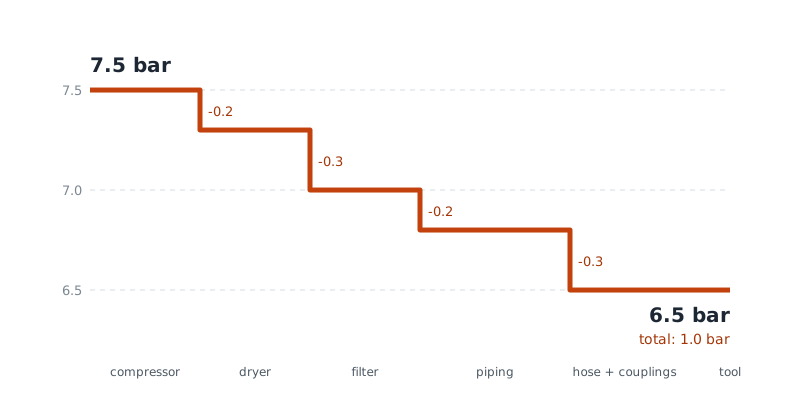
What influences pressure drop
There are two things that influence pressure drop: the size of the obstacle, and the flow rate of the compressed air.
- The bigger the obstacle, the bigger the pressure drop.
- The higher the air flow, the bigger the pressure drop.
With a bigger obstacle, there is more resistance, which results in a bigger pressure drop. For example, a dirty compressed air filter will create a much bigger pressure drop than a new, clean compressed air filter. In fact, the amount of pressure drop is an indicator of how dirty the compressed air filter is!
Also, pressure drop is only created by compressed air flow. If we use more compressed air through a dirty filter, we create a bigger pressure drop than when we use a little compressed air through the same filter. And without flow, there is no pressure drop!
Compare it to a river, or a small stream. If we throw rocks in the stream to create a little dam, the free flow of water is obstructed, and the water level upstream of the rocks will rise. If the river flows faster, the difference in water level will increase. If we put the same rocks in a pond (standing water), nothing happens!
Without flow, there is no pressure drop!
Why do we care about pressure drop?
All great, but why should we care about it?
Pressure drop costs us money. Do I have your attention now :)
Every part in our compressed air piping system creates a small pressure drop, and all those pressure drops add up. Don't be surprised if the pressure at your point of use is 1 bar (15 psi) lower than in your compressor room. In fact, I have seen far worse! 2 bar is not uncommon.
But what does this mean? If we need 6 bar of air pressure for our consumer to work correctly, we now need to set our air compressor to 7 bar, to account for the pressure drop! And every increase in pressure increases our energy cost, because the compressor has to work harder (use more energy) to compress the air to a higher pressure.
What that costs. As a rule of thumb, every 0.1 bar increase in pressure costs us 0.7% extra in energy cost. With a 1 bar pressure drop, that's 7% extra. So if the annual electricity bill for your air compressor is $20,000 (a single medium sized compressor), that's $1,400 you are paying for pressure drop!
Solving pressure drop problems
The most common way to 'solve' pressure drop problems is to increase the pressure setpoint of the air compressor. As we saw before, this costs extra energy.
Sometimes, a new compressor is installed. The problem is low pressure at the point of use, so an extra compressor, or a bigger compressor, must solve the problem, right? Unfortunately, this is not true. What this does is increase the production capacity of compressed air. But that compressed air still has a hard time reaching the air users (pressure drop).
What would help, is to buy a compressor that is capable of a higher pressure. For example, we exchange our 8 bar air compressor for a 12 bar air compressor. But that is not really solving the problem. This 'solution' costs a lot, both in investment (purchasing a new compressor) and in running costs (extra energy to overcome the pressure drop).
The real fix is almost always in the system itself: clean or replace dirty filters, remove unnecessary restrictions, and get the piping right. For that last part, see compressed air pipe sizing.
More on pressure drop
- How Much Pressure Drop is Normal? The budget: what each component may take, and when to act.
- How to Measure Pressure Drop Find your pressure drop with the gauges you already have.
 Written by Cas · Updated Aug 2026