
Motor overload relay keeps tripping—either the motor is drawing excessive current, or the relay itself has become too sensitive. These safety devices are also called "thermal block"
What this problem usually means
The motor overload relay is designed to protect the motor from damage due to overcurrent. When it trips repeatedly, the motor is either drawing too much current (mechanical or electrical problem), or the relay itself has degraded and become oversensitive.The key diagnostic is measuring actual motor current. If current is high, find out why. If current is normal but the relay still trips, the relay is likely faulty.
That being said, If the overload relay trips immediately on startup, there's probably an actual overload and you need to investigate accordingly.
If it trips at 'random' times during normal operation, on older machines, the overload relay often simply become hyper sensitive and need to be replaced. There's nothing actually wrong with the compressor in this case. Measure currents in no-load and load condition to make sure they are within normal range.
If the thermal overload relay has been replaced, and the compressor still trips occasionally, but of course never when you are there, this can be a difficult thing to diagnose. Sometimes specific conditions trigger an actual overload, like maximum compressor load for extended time during peak hours, and at the same time a voltage drop across the whole factory or the specific compressor (maybe other machines nearby startup, draw extra power, etc).
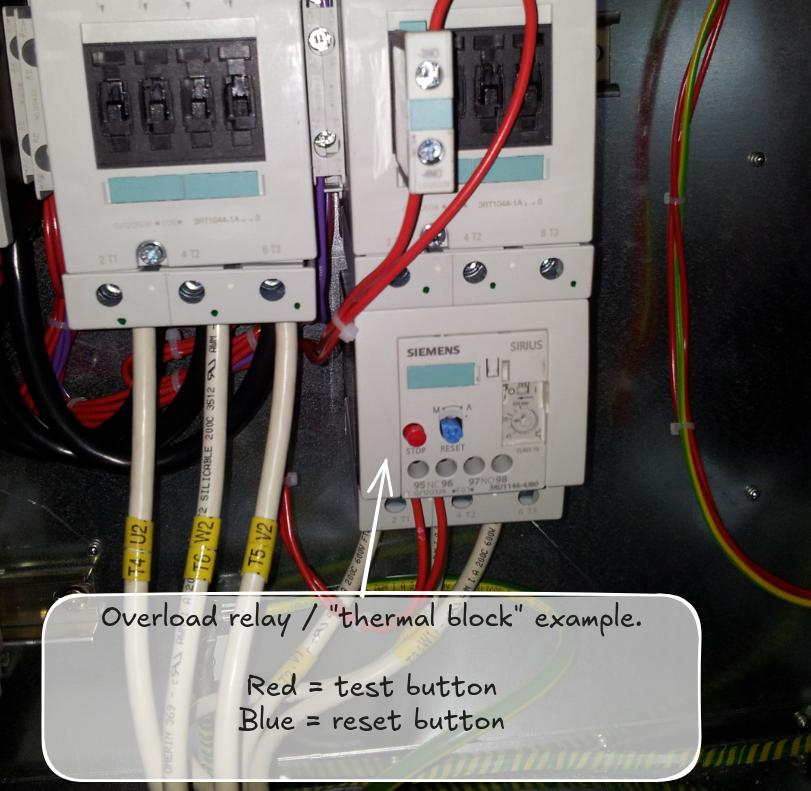
A thing to keep in mind is that these thermal overload relays have a specific curve they 'follow' to trip. A heavy overload will immediately trip the breaker. But a slight (few percent) overload slowly heats up the overload block and trips it after maybe 30 minutes to an hour!
More info in my article "How the overload relay works"
Check these first
5–10 minute checks before diving deeper
- Measure motor current with a clamp meter during operation—compare to nameplate FLA
- With compressor OFF and locked out, try turning the airend by hand—should rotate smoothly without binding
- Check motor winding insulation with a megger—should be in the megohm range
- Measure voltage at motor terminals during starting and running—significant drop indicates connection problem
- Verify all three phases are present and balanced
- Check all electrical connections, fuses, and contactors for signs of heat or corrosion
- Verify overload relay is set to correct current rating for the motor
- If current is normal and relay still trips, replace the relay (they become sensitive with age)
Common root causes
Why this happens in rotary screw compressors
- Mechanical binding in airend Worn bearings, seized airend, or internal damage causes motor to work harder. If you can't turn the airend by hand (locked out!), something is mechanically wrong.
- Motor winding problem Degraded winding insulation or shorted turns cause excessive current. Test insulation with megger—should read megohms, not kilohms.
- Voltage drop or bad connection Loose connection, corroded terminal, or undersized wiring causes voltage drop under load. Motor draws more current to compensate.
- Phase loss or imbalance Missing phase or significant phase imbalance forces remaining phases to carry extra load. Check all three phases under load.
- Overload relay worn or misadjusted Thermal overload relays become oversensitive with age and heat cycling. If motor current is normal but relay trips, replace the relay.
Don't simply increase the overload relay setting or bypass it to "fix" the problem. The relay is protecting the motor from damage. If current is high, find and fix the root cause. Raising the setting just moves the failure from relay trip to motor burnout.
Before testing motor windings or checking connections, ensure power is locked out and tagged out. Capacitors in VFD drives can hold dangerous voltage. Only qualified personnel should perform electrical testing.
Still stuck?
If the checks above haven't pointed at the cause, post your symptoms in the Q&A. Real-world answers, no sales pitch.