
There are 3 main units that we use in our compressed air world: pressure, volume and capacity. Consider them your new best friends. Come with me and I'll introduce you to each one of them. Don't worry, they are very friendly.
I like to think of pressure as 'how strong', volume as 'how much', and capacity as 'how often' or 'how fast'.
You will see many different units being used, especially for volume and capacity. But it doesn't really matter whether you use liters per second or CFM (cubic feet per minute) or any other unit (coffee cups per week?). You can make up your own units if you want to! Just remember that they all express the same thing: pressure, volume or flow.
Pressure
Pressure is 'how strong' compressed air is. It's how hard the compressed air pushes against an object, like the piston in a pneumatic cylinder. You will often see it expressed as either bar or PSI: 1 bar = 14.5 PSI.
If we move a piston with compressed air, the pressure pushes the piston out. If we double the pressure of the compressed air, we double the outward force of the piston. Double the pressure from 3 bar to 6 bar, and the force of the pneumatic cylinder doubles from 1 kN to 2 kN.
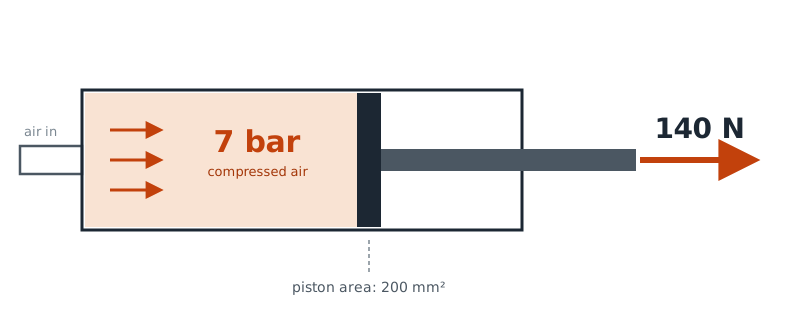
Pressure is actually a 'force per area'. We can see this clearly in the imperial unit of PSI: Pounds per Square Inch. At 100 PSI, we have 100 pounds of force on every square inch. If our piston has an area of 4 square inch, the outward force is 4 × 100 = 400 pounds of force.
In metric: 1 bar is 0.1 N/mm² (Newton per square millimeter). So if we have compressed air of 7 bar, pushing against a piston with an area of 200 mm², the resulting force is 7 × 0.1 × 200 = 140 Newton.
Increasing pressure
Pressures can't be added up. If we have two air compressors of 7 bar, we still have a 7 bar air supply. We only doubled the volume of compressed air that we can deliver. If we buy a new machine that needs a 12 bar compressed air supply, we have a problem! We will need to buy a new 12 bar air compressor.
Absolute pressure and gauge pressure
There are two types of pressure: absolute pressure and relative, or 'gauge', pressure. This confuses people sometimes, but trust me, it's really simple. The only difference is the reference pressure: what is 'zero'?
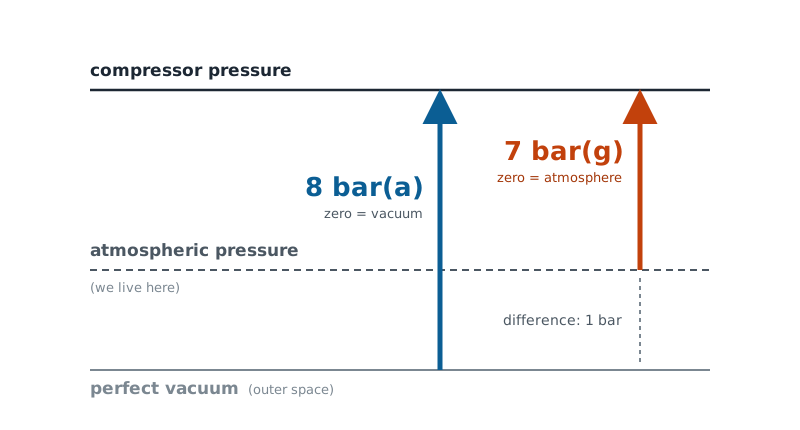
You don't notice it, but here on earth we live under a thick layer of air, the atmosphere. The air pushes down on itself, because of gravity, creating... compressed air. We live IN compressed air here on the surface of the earth. The pressure? 1 'atmosphere'. That's around 1.013 bar (let's just say 1 bar), or 14.7 PSI.
For relative (gauge) pressure, 'zero' is the pressure on the earth's surface. For absolute pressure, 'zero' is the pressure in outer space, a vacuum. The difference between absolute and relative pressure is 1 bar. Simple as that.
| Absolute, bar(a) | Gauge, bar(g) | |
|---|---|---|
| 'Zero' is | a perfect vacuum | atmospheric pressure |
| Your 7 bar compressor reads | 8 bar(a) | 7 bar(g) |
| When you need it | calculations | everything else |
In compressed air land, we normally talk about relative / gauge pressure. If you see a gauge in your compressed air system, that's gauge pressure (that's probably where the name came from). The only time you will need absolute pressure is when doing calculations.
Volume
Volume is easy to understand, we use it often in daily life: a carton of milk, a bottle of water. Volume is 'how much'. In compressed air land, think of a 1000 liter air receiver.
We can add up volumes. If we install two air receivers of 1000 liter, we have a 2000 liter air buffer.
Capacity
Capacity, or air flow, is volume per time unit. Some examples: liters per second, m³ per minute, CFM (cubic feet per minute). Capacity is 'how often' or 'how fast'.
Where is it used in compressed air land? On one side, to express the output capacity of an air compressor: how much compressed air the compressor can deliver per minute (or second, or hour). On the other side of the system, we use it to express the air consumption of a machine or air tool: the amount of air that a machine needs per second, minute or hour.
Capacities, or air flows, can be added up. If we have two air compressors of 7 bar, and the first one delivers 30 l/s and the second one delivers 50 l/s, we have a total air supply of 80 l/s. The same is true for air consumers: if we have two machines that both use 400 m³/hr, we have a total air consumption of 800 m³/hr.
Compressor capacity and FAD
To be more precise about 'air flow', we should say 'volume flow', since there's also a thing called 'mass flow'. And the actual air flow in the pipe is much smaller than the volume of ambient air the compressor takes in. That's why, to be able to easily compare air compressors, we use Free Air Delivery (FAD) to state the compressor capacity: the flow at the compressor outlet, calculated back to inlet conditions.
For more info, go to the detailed explanation of Free Air Delivery.
 Written by Cas · Updated Aug 2026